From Catchment to Coral Reef: Water Quality and Aquatic Animal Health
By: Chris Walster BVMS MVPH CertAqV MRCVS, WAVMA Communications Committee
Section Content:
1. Summary - coral health does not begin at the reef
2. Water quality is part of the health picture
3. Following pollution from source to reef
4. Monitoring should connect exposure with biological response
5. What can aquatic veterinarians contribute?
6. Science alone will not determine success
7. From detecting deterioration to demonstrating recovery
8. Further reading
9. Key Terms and Definitions
Healthy and Unhealthy Coral
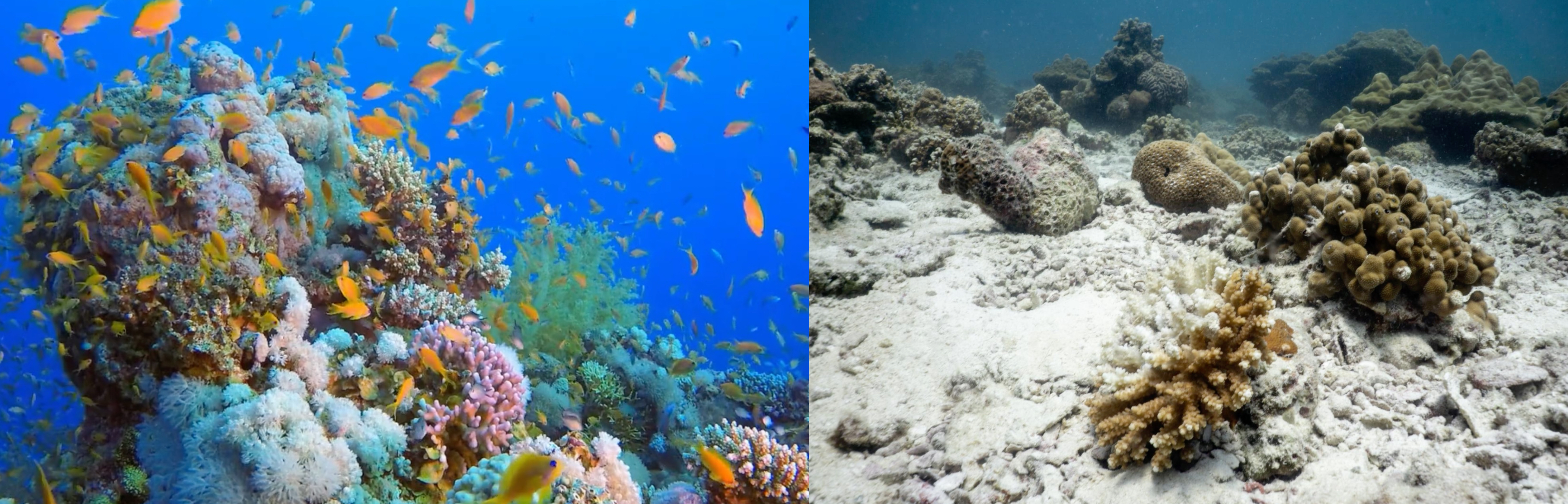
Coral health does not begin at the reef
Wastewater entering groundwater, nutrients lost from agricultural land, sediment mobilised during storms and pollutants carried by rivers can all influence conditions many kilometres downstream. By the time deteriorating water quality is detected around a coral reef, its source may be distant in both space and time.
A new research and development roadmap from the G20 Coral Research & Development Accelerator Platform (CORDAP) places this connection at the centre of coastal water-quality management.
Developed following an international workshop in Fiji in October 2025, the Integrated Coastal and Marine Water Quality Roadmap identifies research priorities for reducing land-based pollution affecting coral reefs and other coastal habitats.
Its central message is straightforward: protecting reef health requires understanding pollution from its source, through the pathways that transport it, to the ecosystems and organisms ultimately exposed.
For aquatic veterinarians and other animal health professionals, this perspective is particularly relevant. It extends the focus beyond responding to disease or ecological deterioration after it appears, towards understanding the environmental conditions that can contribute to poor health, reduced resilience and impaired recovery.
Water quality is part of the health picture
Climate change remains the greatest long-term threat to coral reefs. Improving local water quality cannot prevent ocean warming, but reducing land-based pollution can improve the conditions in which reefs experience and recover from environmental stress.
The CORDAP roadmap focuses particularly on pollution associated with sanitation and agriculture, including nutrients, sediments, pathogens, organic matter and selected contaminants. These can reach coastal ecosystems through surface runoff, rivers, groundwater and coastal circulation.
The roadmap does not currently address every form of marine pollution. Plastics, industrial effluents, port pollution, oil spills, aquaculture waste and emerging contaminants are outside its present scope, although they remain important areas for research and management.
This distinction matters for aquatic health.
Water-quality deterioration is not simply a chemistry problem. Pollutant exposure can be associated with changes in microbial communities, algal growth, coral condition, disease risk, recruitment and recovery. This is why environmental monitoring becomes more useful when measurements of exposure are considered alongside biological response.
Following pollution from source to reef
One of the most useful aspects of the roadmap for aquatic health professionals is its catchment-to-reef framework.
It considers five connected elements:
- Sources, where pollutants are generated.
- Pathways, including runoff, rivers, groundwater and coastal circulation.
- Receptors, where organisms and ecosystems are exposed.
- Responses, including interventions intended to reduce pollution or interrupt its movement.
- Monitoring and indicators, which help determine whether environmental and biological conditions improve.
This framework helps explain why management confined to the marine environment is unlikely to address every source of poor reef water quality.
An intervention may take place on a farm, within a wastewater system, beside a river or at the coast. Its success, however, may also need to be assessed by asking whether downstream exposure has changed and whether the receiving ecosystem is responding.
For aquatic animal health teams, this provides a useful extension of conventional disease investigation. Identifying a pathogen or lesion may remain essential, but understanding exposure history, hydrological connections, pollution events and changing conditions elsewhere in the catchment can provide important additional context.
Priority 1: Sanitation, wastewater and One Health
Domestic wastewater is the first major priority identified by the roadmap.
Wastewater can carry nutrients, organic matter and disease-causing microorganisms into groundwater, rivers and coastal waters. In many reef regions, sanitation systems have historically focused primarily on human health and service delivery, while the sensitivity of downstream ecosystems has received less attention.
The roadmap therefore calls for better methods to quantify wastewater pollution reaching marine environments, identify reefs at greatest exposure risk and determine whether improvements in sanitation lead to measurable ecological benefits.
This has clear One Health relevance.
Better wastewater management can have implications for human health, ecosystem condition, fisheries, recreation and water security. Looking at those outcomes together encourages decisionmakers to consider sanitation not only in terms of treatment performance, but also in terms of the wider systems affected by wastewater discharge.
Veterinarians, microbiologists and aquatic disease specialists could contribute to this work through pathogen surveillance, microbial risk assessment and the development of biologically meaningful indicators of exposure.
The roadmap also highlights the importance of water-quality guidelines and discharge standards that reflect the sensitivity of receiving ecosystems.
For aquatic health professionals, the practical implication is important: a technically compliant discharge does not automatically demonstrate that exposure is biologically insignificant for a sensitive ecosystem. Understanding concentration, duration, timing and biological response remains essential.
Priority 2: Connecting agriculture, catchments and reefs
Agricultural pollution presents a different challenge because sources can be diffuse and spread across large areas.
Nutrients, sediments and agricultural contaminants may travel by several routes. Heavy rainfall can generate short but significant pollution pulses, while groundwater can transport substances that are less visible than surface runoff. Pollutants stored in soils and sediments can also complicate the relationship between management action and downstream improvement.
The roadmap therefore emphasises better identification of pollution pathways and hotspots, supported by field measurements, remote sensing, modelling and improved monitoring.
It also highlights the need to test agricultural and land-management practices designed to reduce nutrient, sediment and contaminant losses.
The important point is that success should not be measured only at the farm boundary.
Reducing runoff or fertiliser loss is valuable, but the wider management question is whether those changes eventually reduce pollutant exposure downstream and contribute to improved environmental condition at the reef.
This principle is directly relevant to aquatic animal health research. Where possible, environmental interventions should be evaluated using meaningful biological and ecological outcomes alongside engineering or water-chemistry measurements.
Potential reef indicators include water clarity, algal cover, coral recruitment, disease occurrence and recovery following disturbance. Selecting appropriate indicators requires an understanding of both the exposure being managed and the biological response that matters.
Priority 3: Nature-based solutions need evidence too
Wetlands, riparian vegetation, mangroves and other natural or restored systems can help intercept nutrients and sediments before they reach marine environments. Other approaches, including appropriately designed living shorelines or coastal treatment systems, may also help reduce pollution or sediment movement in some settings.
These nature-based solutions may offer additional benefits, including habitat provision, biodiversity conservation, carbon storage and coastal protection.
However, plausible benefits are not the same as demonstrated effectiveness.
The CORDAP roadmap calls for field testing to establish which interventions work, under what conditions, how they perform during events such as storms, what maintenance they require and whether reduced pollution is accompanied by measurable improvement in coral condition.
It also highlights the need for monitoring approaches that can connect intervention performance with pollution exposure and reef response.
Aquatic animal health expertise could strengthen this evidence base. Disease surveillance, health assessment and diagnostic methods can provide additional biological information alongside physical and chemical monitoring.
Monitoring should connect exposure with biological response
A recurring theme throughout the roadmap is the need to connect datasets that have traditionally been considered separately.
Conventional water sampling can increasingly be supplemented by tools such as automated sensors, remote sensing, drones and integrated data platforms. These technologies can improve the ability to detect short-lived events that periodic sampling might miss.
Technology itself, however, is not the objective.
Monitoring should begin with a clearly defined management question.
For coral reefs, this can mean combining measurements of nutrients, turbidity, suspended sediments and microbial contamination with ecological indicators such as algal cover, coral disease, recruitment and recovery.
The principle is familiar in veterinary diagnostics. A test has greatest value when it answers a defined clinical or population-health question.
The same applies to environmental monitoring. Its usefulness increases when there is a clear framework connecting management action, pollutant exposure and biological response.
That framework also makes it easier to see where evidence is missing.
What can aquatic veterinarians contribute?
The CORDAP roadmap was developed for a broad community of researchers, governments, practitioners and funders. It is not specifically a veterinary roadmap.
Nevertheless, several of its priorities overlap strongly with aquatic animal health expertise.
Aquatic veterinarians and other health professionals could contribute to surveillance programmes that integrate environmental and animal-health information; microbial and disease sampling; interpretation of disease patterns alongside environmental exposure; development of meaningful health endpoints for intervention studies; and risk assessment where animal, ecosystem and human health intersect.
Veterinary expertise may also be useful when designing studies intended to distinguish association from meaningful evidence of biological response.
Consistent diagnostic methods, appropriate comparison sites, suitable baseline information and consideration of other environmental stressors all matter when assessing whether an intervention is genuinely associated with better biological outcomes.
The roadmap also stresses that pollution does not act in isolation. Warming, bleaching, disease and other pressures interact with local environmental conditions. Addressing these relationships will require collaboration between environmental scientists, ecologists, engineers, microbiologists, modellers and aquatic health professionals.
Science alone will not determine success
Another important message from the roadmap is that a technically effective intervention is not automatically a sustainable one.
A wastewater system may perform well but fail over time if communities cannot afford or maintain it. An effective agricultural practice may have limited impact if it is impractical for farmers to adopt. A promising nature-based solution may remain a small pilot project if there is no suitable governance or financing pathway for wider implementation.
The roadmap therefore places governance, finance, capacity building and community participation alongside its technical research priorities.
It also emphasises co-design involving communities, Indigenous partners, governments, businesses, researchers and civil society.
For veterinary and animal health professionals, the principle is familiar. Health interventions are most likely to succeed when they function within the practical, social and institutional systems in which animals and people live.
From detecting deterioration to demonstrating recovery
Perhaps the most useful shift in the CORDAP roadmap is the emphasis on moving beyond documenting pollution towards demonstrating whether action produces meaningful improvement.
Reducing fertiliser loss, upgrading wastewater treatment or restoring a wetland can all be significant achievements. For coral reef protection, however, these actions are part of a longer chain.
The wider questions are whether pollution reaching the reef decreases and whether environmental and biological conditions subsequently improve.
This is an area in which aquatic animal health professionals can make a valuable contribution.
Veterinary medicine brings expertise in exposure assessment, disease investigation, diagnostics, surveillance and outcome measurement. Applied within a catchment-to-reef framework, these skills can help ensure that biological health is measured rather than simply assumed as a benefit of improved water management.
Cleaner coastal water cannot remove the threat posed by a warming ocean. It can, however, reduce some local pressures and improve the conditions in which coral reefs and associated aquatic communities must survive and recover.
The CORDAP roadmap makes the case for looking far beyond the reef itself, connecting sanitation, agriculture, catchment management, ecosystem restoration, monitoring and health science across the source-to-sea system.
For aquatic veterinary medicine, that broadens the meaning of preventive health. Sometimes protecting an animal begins kilometres upstream.
Further Reading
Devlin M, Rowell D, Steckbauer A, et al. (2026). Integrated Coastal and Marine Water Quality: Research and development priorities for solutions to reduce land-based sources of pollution affecting coral reefs (and other coastal habitats). CORDAP.
The principal roadmap on which this article is based. It sets out research and development priorities across sanitation, agriculture and integrated land-sea management, nature-based solutions, and monitoring for improved coral reef water quality.
Devlin M, Rowell D, Steckbauer A and Wenger A. (2026). From catchment to coral reef: a new roadmap for cleaner coastal waters. Cefas Marine Science.
An accessible overview of the roadmap and its catchment-to-reef approach, including the links between pollution sources, transport pathways, ecological exposure and management responses.
United Nations Environment Programme. (2018). Wastewater Pollution on Coral Reefs: Science-to-Policy Brief on Managing Wastewater to Support Coral Reef Health and Resilience.
Useful background on the relationship between wastewater pollution, coral reef condition and management responses.
NOAA Ocean Service. How does land-based pollution threaten coral reefs?
An accessible introduction to the effects of sediments, nutrients, pathogens and other land-based pollutants on coral reef ecosystems.
Carlson RR, Foo SA and Asner GP. (2019). Land Use Impacts on Coral Reef Health: A Ridge-to-Reef Perspective. Frontiers in Marine Science, 6:562. https://doi.org/10.3389/fmars.2019.00562
A peer-reviewed review of the connections between land use, pollutant transport and coral reef condition across ridge-to-reef systems.
Apprill A and Salerno JL. (2025). Reef water microorganisms as diagnostic indicators for coral reef ecosystem management and sustainability. Cell Reports Sustainability, 2(5), 100403. https://doi.org/10.1016/j.crsus.2025.100403
Further reading on the potential use of reef-water microbial communities as indicators to support coral reef monitoring, management and restoration.
Source note
This article is based primarily on the 2026 CORDAP Integrated Coastal and Marine Water Quality roadmap and the accompanying Cefas Marine Science article, From catchment to coral reef: a new roadmap for cleaner coastal waters. Additional sources listed above provide supporting background on wastewater pollution, land-to-reef connections and biological monitoring.
Key terms and definitions
- Aquatic animal health
The health and wellbeing of animals that live in marine or freshwater environments, considered alongside the environmental conditions that can affect them. - Aquatic veterinarian
A veterinarian with expertise in the health, disease, welfare and management of aquatic animals. - Biological endpoint
A measurable biological change used to assess the effects of an exposure or intervention, such as disease occurrence, coral recruitment or recovery. - Catchment
An area of land where rainfall and surface water drain into the same river, lake, estuary or coastal system. - Catchment-to-reef
An approach that follows water, pollutants and environmental pressures from their source on land through rivers, groundwater and coastal waters to coral reefs. - Coastal circulation
The movement of seawater along and around coastlines, which can transport nutrients, sediments, pollutants and microorganisms. - Confounding stressors
Other environmental or biological pressures that may influence an observed effect, making it harder to determine the role of one particular factor. - Contaminant
A substance present in the environment that may affect water quality, organisms or ecosystem health. - Coral bleaching
The loss of microscopic algae living within coral tissue, often caused by environmental stress such as unusually high-water temperatures. Bleached corals are not necessarily dead, but prolonged or severe stress can reduce their chances of survival. - Coral recruitment
The process by which young corals settle, establish and become part of a reef community. - Ecological receptor
An organism, population, habitat or ecosystem that may be exposed to and affected by an environmental pressure or pollutant. - Groundwater
Water stored beneath the land surface in soil and rock. Groundwater can carry nutrients and other pollutants from land into coastal environments. - Hydrological connectivity
The way water moves between different parts of a landscape, such as soils, groundwater, rivers, wetlands, estuaries and coastal waters. - Land-based pollution
Pollution that originates on land and reaches rivers, groundwater or marine environments through pathways such as runoff, wastewater discharge or erosion. - Load apportionment
The process of estimating how much pollution comes from different sources, such as agriculture, wastewater or other activities. - Microbial contamination
The presence of microorganisms in water or the environment, including bacteria, viruses or other microbes that may affect animal, human or ecosystem health. - Nature-based solutions
Actions that protect, restore or manage natural systems to address environmental challenges, such as using wetlands, mangroves or riparian vegetation to reduce pollution or erosion. - Nutrient pollution
The excessive input of nutrients, particularly nitrogen and phosphorus, into aquatic environments. High nutrient levels can alter ecological processes and encourage excessive algal growth. - One Health
An approach that recognises the close connections between human health, animal health and environmental health. - Pathogen
A microorganism or other biological agent capable of causing disease. - Pollutant pathway
The route by which a pollutant moves from its source to the environment or organisms that may be exposed to it. - Reef resilience
The ability of a coral reef ecosystem to withstand disturbance, recover from stress and continue to function. - Remote sensing
The collection of environmental information from a distance, often using satellites, aircraft or drones. - Riparian vegetation
Plants growing alongside rivers, streams and other waterways. These areas can help reduce erosion and intercept sediments and nutrients before they enter the water. - Runoff
Water that flows across the land surface following rainfall or irrigation, potentially carrying soil, nutrients, chemicals and other pollutants into waterways. - Sediment
Particles of soil, sand or other material that can be transported by water. Excessive sediment can reduce water clarity and affect coral reef habitats. - Source-to-sea
A way of understanding environmental processes by considering the entire pathway from inland sources through rivers, groundwater and coastal systems to the ocean. - Turbidity
A measure of how cloudy or unclear water is because of suspended particles such as sediment or organic material. - Wastewater
Water that has been used by households, businesses or other activities and may contain nutrients, organic matter, microorganisms and other contaminants. - Water quality
The physical, chemical and biological characteristics of water that influence its suitability for organisms, ecosystems and human uses. - Water-quality indicator
A measurement used to assess environmental condition or change, such as nutrient concentration, turbidity, microbial contamination, coral disease or algal cover.